How your Rates are calculated
How Council rates are calculated in Victoria
Rates are an important part of your council's ability to fund and deliver essential community infrastructure and services.
The rates your council collects are a form of property tax. The value of each property is used as the basis for calculating what each property owner will pay.
How your rates are calculated
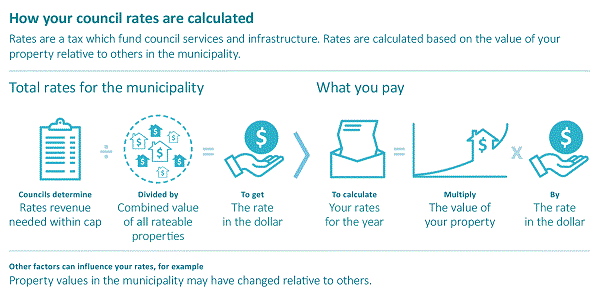
When deciding how much it needs to raise in general rates, your council considers community needs in relation to its available income for the coming year. This is done when your council is preparing its annual budget.
The total amount of money to be raised in general rates is divided by the total value of all rateable properties in your area. The resulting figure is called the 'rate in the dollar'. The council will then determine the amount to be paid in rates by applying a 'rate in the dollar' to the assessed value of each property.
Rating categories
General rate set at 100% of the General rate and charged on any rateable land which does not have the characteristics of Primary Producer Land, Commercial Land, Industrial Land and Vacant Land.
Vacant General rate set at 100% of the General rate charged on any land that does not have the characteristics of Primary Producer Land, Commercial or Industrial Land and has no buildings or permanent structures erected on it.
Primary Production rate is a lower rate set at 70% of the general rate and charged on properties that qualify under Glenelg Shire Council’s Primary Production definition. Primary Production properties are defined as 40 hectares or more in area.
Commercial rate set at 100% of the General rate and charged on any land, which is used primarily for commercial purposes and/or for the sale of goods or services and if developed, would likely be used primarily for commercial purposes or for the sale of goods or services.
Industrial rate set at 100% of the General rate and charged on any land that does not have the characteristics of Primary Producer Land, Vacant Land or Commercial land. Industrial land is used predominantly for industrial purposes incl manufacturing, repairing, servicing, re/processing or warehousing.
Differential Rates
Council’s differential rates as of 1 July 2026 are -
|
Rating Categories
|
Differential Rate
|
|
General
|
100%
|
|
Vacant General
|
100% |
|
Primary Production
|
70%
|
|
Commercial
|
100%
|
|
Industrial
|
100% |
Supplementary Rates
Supplementary Valuations are carried out when properties are physically changed by the following –
- Buildings being erected, demolished or altered; or
- Properties being amalgamated, subdivided, portions sold off.
Upon receipt of approved building, planning or subdivision files, Council’s Valuers will undertake supplementary valuations of the property.
Once a Valuation is determined, Council adopts the revised values for rating purposes and issues a revised Supplementary Notice.